They passed the bill. Here’s who gets to pay it.
The One Big Beautiful Bill is law. Its Medicaid work requirement takes effect nationwide on January 1, 2027. This is the itemized receipt: what it costs, who comes out ahead, and the 270 officials who put their names on it.
Find your line on the receipt.
Pick your household’s income. You’ll see the average change for households like yours, with taxes and the value of health and food benefits counted together.
Households earning $53,000 to $96,000
Canary: your copy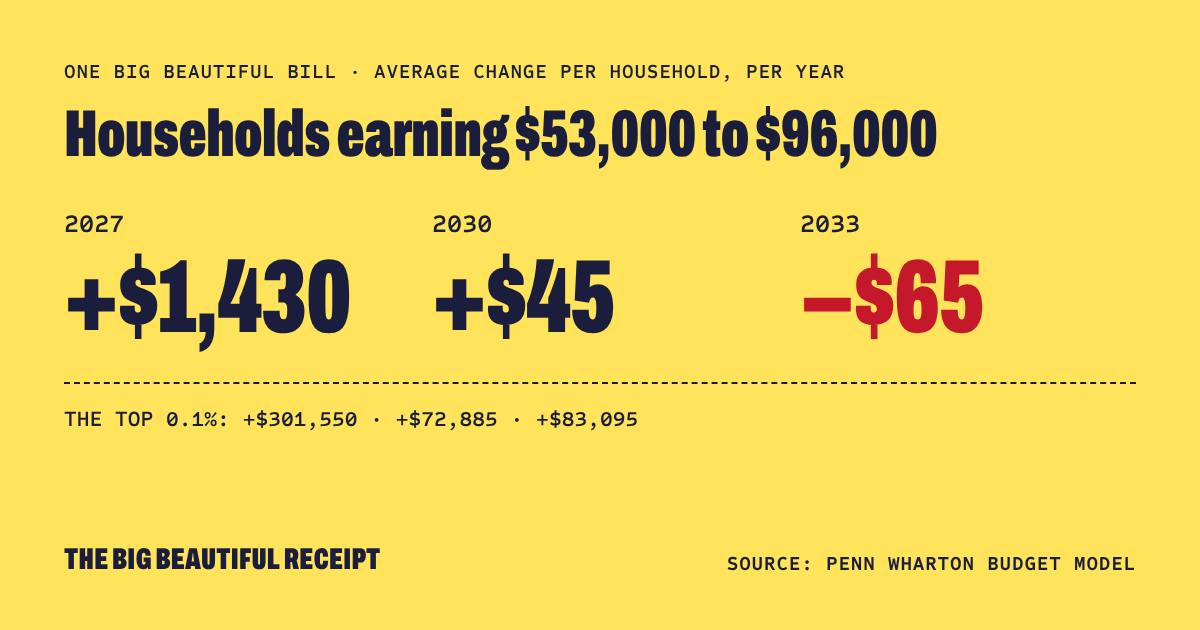
Averages for an income group, not a prediction for your household. Source: Penn Wharton Budget Model, July 2025, Table 5. Compared with the law as it stood before July 4, 2025, when the 2017 tax cuts were set to expire. Medicaid and SNAP are counted at their dollar value, so not every loss is cash. Income cutoffs rise each year. See all nine lines side by side.
of households sit in income groups that come out behind by 2033, on average.
of the law’s total value goes to the top tenth of households.
is the average 2033 gain for the top 0.1%, in the same year the lowest-earning fifth lose $1,305.
Now see who signed for it where you live.
218 representatives and 50 senators voted yes on final passage. Every one is on the public record. Pick your state.
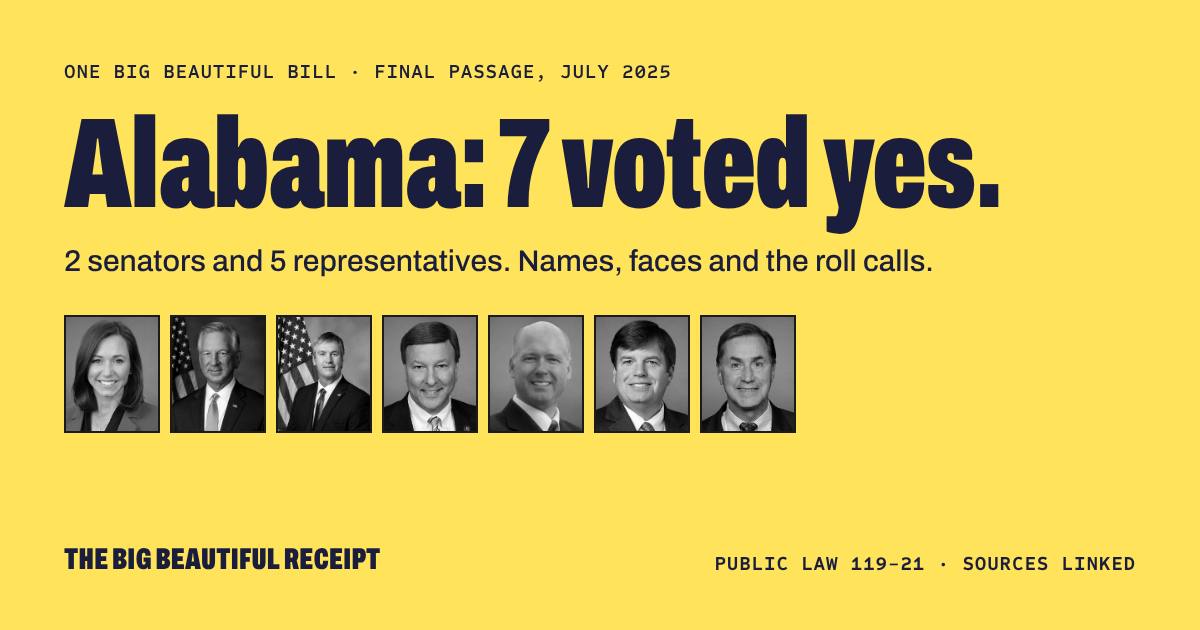
Offices and districts are as of the July 2025 votes. Several states have redrawn districts since, and some members have left office. Not sure who represents you now? Look it up at house.gov.
When each charge posts.
The tax breaks arrived first. The cuts were scheduled for later. Here is the order, from the law and the agencies carrying it out.
- July 4, 2025Posted
Signed. Food-aid rules tighten.
SNAP work rules now reach adults up to age 64 and parents whose youngest child is 14 or older. Internet bills stop counting in the formula that sets a household’s benefit. Source
- January 1, 2026Posted
The estate-tax exemption rises to $15 million a person.
That is $30 million for a married couple, indexed to inflation, with no end date. Without the law the limit was scheduled to fall to about $7 million. Source
- Tax season 2026Posted
The worker deductions show up on returns.
Deductions for tips, overtime, car-loan interest and people 65 and older, plus a $2,200 child credit. Real money for those who qualify. All four deductions end after 2028. Source
- October 1, 2026Posted
Washington halves its share of SNAP’s running costs.
The federal share of state administrative costs drops from 50% to 25%. States cover the difference or cut back. Source
- January 1, 2027Due in 50 days
Medicaid work requirement begins nationwide.
Adults 19 to 64 covered through Medicaid expansion must document 80 hours a month of work, school or service, or about $580 a month in earnings, to keep coverage. Renewals move from yearly to every six months. Exemptions exist but have to be claimed or verified. Nebraska and Montana started in 2026. Source
- Tax season 2027Scheduled
Marketplace insurance: the repayment cap is gone.
If your 2026 income came in above your estimate, you repay the whole excess premium subsidy at tax time. Until this law, repayment was capped for households under four times the poverty line. Source
- October 1, 2027Scheduled
States start paying part of SNAP benefits.
States with payment-error rates of 6% or more owe between 5% and 15% of benefit costs. The law lets some states delay. Source
- After 2028Scheduled
The deductions for tips, overtime, seniors and car loans end.
They apply to income earned through December 31, 2028. The last returns that can claim them are filed in 2029. Source
- January 1, 2030Scheduled
The state-and-local tax deduction cap drops back to $10,000.
The temporary $40,000 cap covers 2025 through 2029. Source
- 2034Scheduled
10 million more people without health insurance.
The Congressional Budget Office’s estimate for that year, compared with what it expected before the law. It does not count the separate expiration of extra Affordable Care Act subsidies. Source
Read the expiration dates.
The new deductions aimed at workers run out. The provisions for businesses and large estates do not.
Ends after 2028
- No tax on tips
- No tax on overtime
- The $6,000 deduction for people 65 and older
- The car-loan interest deduction
Has no end date
- Full, immediate write-offs for business equipment and research
- The 20% deduction for pass-through business income
- The $15 million estate-tax exemption
- The lower individual tax rates first passed in 2017
- The Medicaid and food-aid cuts
Source: Public Law 119-21; IRS summary; Penn Wharton provision list. The higher cap on state-and-local tax deductions also ends, after 2029.
Same law. Other end of the receipt.
Lowest-earning fifth of households, 2027
−$165
Average change for the year. Household income under $18,000.
Highest-earning 0.1% of households, 2027
+$301,550
Average change for the year. Household income over $4.45 million.
Drawn to the same scale:
The first bar is there. At true scale it is less than a pixel wide. Source: Penn Wharton Budget Model, Table 5. Per-household averages; these are not group totals or a transfer from one family to another.
And the corporate line.
What Amazon, Alphabet, Meta and Tesla together reported saving in 2025 from one provision: writing off earlier years’ research costs all at once.
Tesla’s reported federal income tax for 2025, on $5.7 billion of U.S. profit.
The average federal income tax rate 706 large, profitable companies paid in 2025. The rate on the books is 21%. 114 of them paid nothing.
Source: Institute on Taxation and Economic Policy, a left-leaning research group, working from the companies’ own annual reports: four tech companies, 706 companies. These figures reflect this law together with earlier breaks, including the 2017 tax law. A company’s tax saving is not its founder’s personal saving.
The fine print, in the law’s own words.
Six sentences from a very long law. Each one is quoted exactly, with a link that takes you to it.
Passing on wealth
Section 70106
Passing on wealth
Section 70106“by striking “$5,000,000” and inserting “$15,000,000””
In 2026, a person can give away or leave behind up to $15 million before federal gift or estate tax applies. The limit rises with inflation and no longer has an expiration date. It is a tax-free limit, not a payment.
A smaller inheritance
Nothing changes. Estates below about $7 million a person were not going to owe estate tax with or without this law.
A very large inheritance
More passes on untaxed. The limit was $13.99 million in 2025 and was scheduled to drop by about half in 2026; instead it rose and became permanent.
Takes effect: Deaths and gifts after December 31, 2025. · Find this sentence in the law · IRS explanation
Health coverage
Section 71119
Health coverage
Section 71119“The individual works not less than 80 hours.”
Adults covered through Medicaid expansion must meet a monthly requirement to keep coverage. Working 80 hours is one way; school, community service, work programs or enough earnings can also count. Some caregivers and people with certain medical conditions are exempt.
Someone on Medicaid
You may have to show you meet the rule or qualify for an exemption, at application and at each six-month renewal. If the paperwork fails, coverage can end even if you were eligible.
Someone not on Medicaid
No test applies to you. The rule gives you no tax break.
Takes effect: By January 1, 2027. States could start earlier; some may get permission to start later. · Find this sentence in the law · CMS fact sheet
Money for groceries
Section 10104
Money for groceries
Section 10104“Any service fee associated with internet connection shall not be used in computing the excess shelter expense deduction under this paragraph.”
SNAP counts some household bills when it sets a benefit. Under this sentence, the internet bill no longer counts. The Congressional Budget Office expects about $10 less a month for roughly 65% of SNAP households on average over 2026 to 2034.
A household on SNAP
Fewer of your bills count, so your benefit can shrink while the bill stays the same.
A household not on SNAP
Nothing changes directly.
Takes effect: July 4, 2025. Felt as states recalculate each case. · Find this sentence in the law · CBO on SNAP
Overtime pay
Section 70202
Overtime pay
Section 70202“No deduction shall be allowed under this section for any taxable year beginning after December 31, 2028.”
A deduction for the premium part of overtime pay, up to $12,500 a year ($25,000 for a couple filing jointly), shrinking at higher incomes. It lowers income tax only. Social Security and Medicare taxes still apply. And as the quoted sentence says, it ends.
An hourly worker with overtime
A lower income-tax bill for four tax years. If you owe little income tax already, the saving is small.
A salaried worker
Usually nothing. Most salaried jobs are not covered by federal overtime law.
Takes effect: Income earned 2025 through 2028. · Find this sentence in the law · IRS rules and limits
State and local taxes
Section 70120
State and local taxes
Section 70120“in the case of any taxable year beginning in calendar year 2026, $40,400”
People who itemize can deduct up to $40,400 of state and local taxes in 2026, up from $10,000. The larger cap phases down above roughly $505,000 of income and expires after 2029.
If you take the standard deduction
No change. About nine in ten filers take it.
If you itemize
A bigger deduction, mostly for higher-income households in higher-tax states.
Takes effect: Tax years 2025 through 2029. · Find this sentence in the law · The law, section 70120
The child tax credit
Section 70104
The child tax credit
Section 70104“by striking “$2,000” and inserting “$2,200””
The maximum child tax credit rises by $200 to $2,200 and is indexed to inflation afterward. Families must earn enough, and meet new Social Security number rules, to get the full amount.
A lower-income family
The full credit is not automatic. How much you get depends on earnings and how much of the credit is refundable.
A middle-income family
Up to $200 more per child.
Takes effect: Starts with 2025 income. · Find this sentence in the law · IRS guidance for families
The part nobody was sent a bill for.
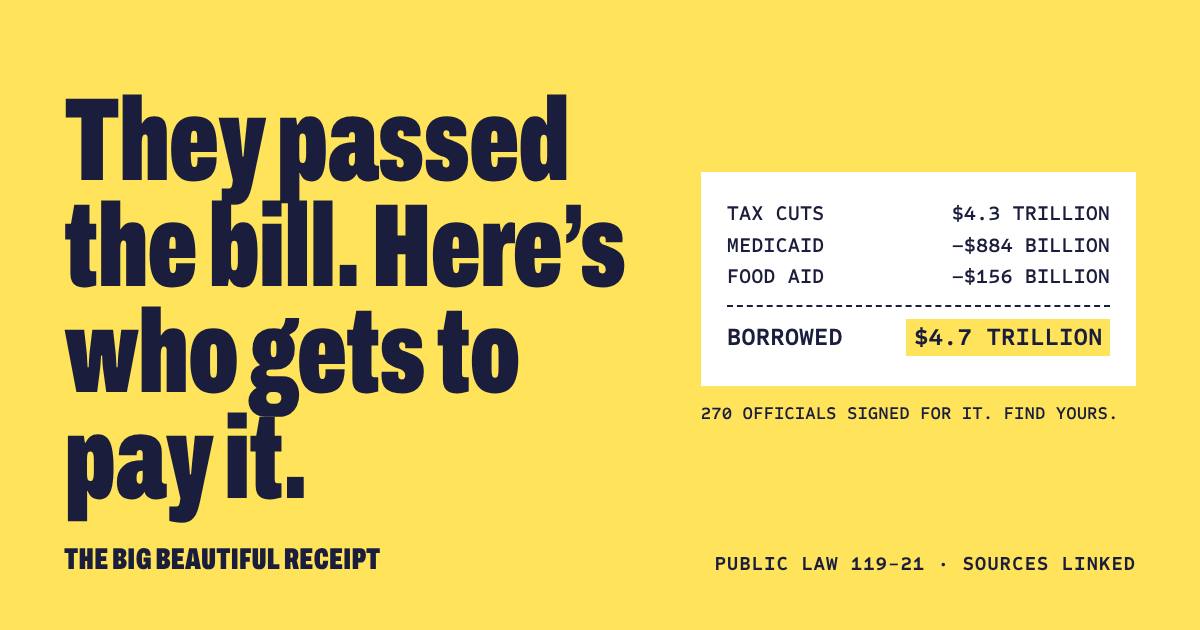
Added to federal deficits, 2026–2035
$4.7 trillion
The Congressional Budget Office’s February 2026 count, including interest and the law’s effect on the economy. Before interest: $3.7 trillion. The spending cuts cover less than a third of the tax cuts and new spending.
CBO, Budget and Economic Outlook, Appendix A · Director’s statement · Penn Wharton on the offsets
More people without health insurance in 2034
10 million
CBO’s estimate of the difference the law makes by 2034. It is a projection for that year, not a count of people cut off on one date, and it leaves out the separate end of extra Affordable Care Act subsidies.
What the bill’s supporters say. And what the scorekeepers found.
You should hear the case for it before you judge it. Then check both against the numbers.
The case for it
- Without it, the 2017 tax cuts would have expired and most households’ taxes would have gone up in 2026.
- It adds deductions for tips, overtime and older Americans, and raises the child credit.
- Work requirements keep Medicaid and food aid for people who work, study, or cannot.
- It funds the border and the military.
- Faster growth will help cover the cost.
What the scorekeepers found
- True: CBO finds eight of ten income groups gain on average over 2026–2034, and growth picks up in 2026.
- Also true: the two lowest groups lose. The poorest tenth are down about $1,200 a year.
- The worker deductions end after 2028. The business and estate provisions do not.
- CBO counts the growth and still finds deficits $4.7 trillion higher.
Pass the receipt.
Send it to one person who should see their line. Every number here comes with a way to check it.
The share buttons are plain links. Nothing on this site tracks who you are or what you send.
Check us. Then check the law.
Quotes are the law’s exact words. Estimates link to the people who calculated them. The framing is ours.
How this site works
We use the law as signed, not an earlier draft. “One Big Beautiful Bill” is the name most people know; the official citation is Public Law 119-21. The household figures come from one source, the Penn Wharton Budget Model, so the lines can be compared with each other. Where the Congressional Budget Office measured the same thing differently, we show both.
The roster comes from the two final-passage roll calls and nothing else. It lists yes votes only. It does not track who has since left office.
This site was built with AI assistance (ChatGPT and Claude). That is one more reason every figure links to its source: so you never have to take our word for it.
It sets no cookies, runs no analytics and loads nothing from anyone else’s servers. Figures were reviewed November 12, 2026. Projections describe what analysts expect, not what has already happened, and laws change.